
Important note: This guide is general planning information, not legal, tax, or accounting advice. Registration duties turn on each state’s own statute and on facts specific to your organization. Verify current requirements with the relevant state agency and a qualified professional.
Key takeaways
- Charitable solicitation registration is a state duty, not a federal one. Most states require an organization to register with a state agency before asking that state’s residents for contributions. The IRS describes those statutes as generally requiring registration before soliciting, names the National Association of State Charity Officials, and links every state through its State Links directory.
- Federal recognition and state registration are separate systems. A determination letter answers a federal question; it does not answer a state one.
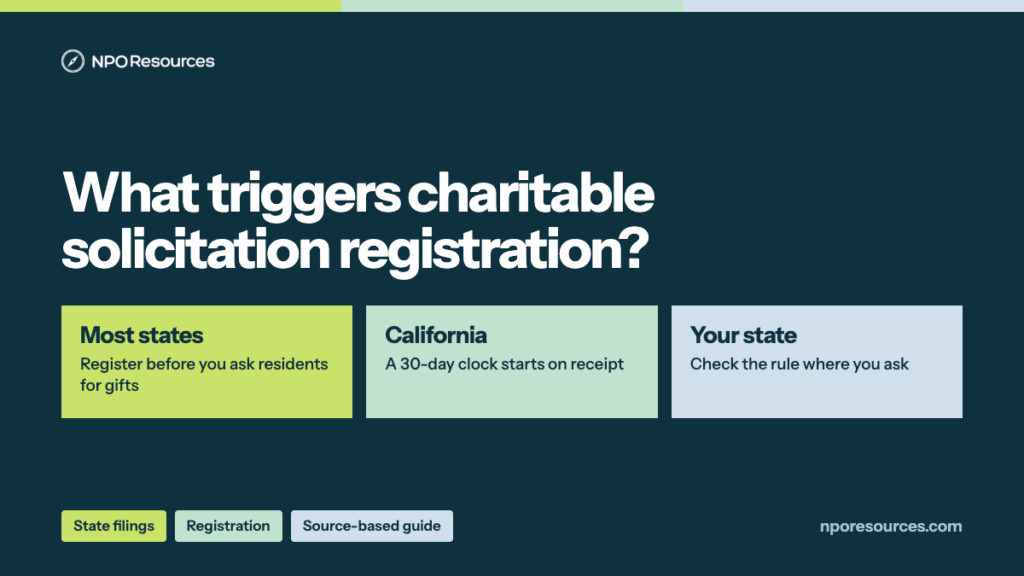
- What triggers the duty is not the same everywhere. Ohio, New York, Pennsylvania, Florida and North Carolina key it to soliciting. California keys it to receiving property, within 30 days.
- “Register before you ask” is really three standards. Ohio and New York require a filing first. Pennsylvania, Florida and North Carolina require approval — Pennsylvania and Florida by barring solicitation before it, North Carolina by building it into the license. California requires neither.
- Exemptions are not a shared list. The same hospital foundation is exempt in Pennsylvania and registrable in Ohio, because the two states are not asking the same question.
On this page
- The letter that answers a different question
- What actually triggers charitable solicitation registration
- Filing first, or approval first
- Why the exemption lists do not match
- The donate button question
- There is no single multistate filing
- How to work out where you stand
- Related NPO Resources guides
- Need help with nonprofit accounting and reporting?
- Sources reviewed
- Frequently asked questions
The letter that answers a different question
The determination letter arrives and it feels like the end of something. Months of Form 1023, the narrative rewritten four times, the budget projections nobody enjoyed building — and then a letter that says, in effect, yes.
So the first appeal goes out. Then the email to the list your board built. Then the donate button goes live, because that is what you built the website for.
Somewhere in that sequence, in most states, an obligation started that nobody sent a letter about.
That letter answered a federal question. Whether a different government — the one where the person reading your appeal actually lives — needs to hear from you first is something the IRS never asked. The IRS is direct about this:
Many states have laws regulating the solicitation of funds for charitable purposes. These statutes generally require organizations to register with a state agency before soliciting the state’s residents for contributions, providing exemptions from registration for certain categories of organizations.
Three facts sit inside that sentence: registration generally comes before soliciting, what matters is asking that state’s residents, and there are exemptions by category. Each turns out to be more complicated than it sounds.
Ohio’s Attorney General lays out the structure plainly. Its guide for new charities gives three headings — the Secretary of State, which “[r]eceives and approves articles of incorporation for Ohio business entities”; the IRS, which “[r]eviews and makes decisions on applications for tax exempt status”; and the Attorney General’s Charitable Law Section, which “[r]egisters and reviews charitable organizations/organizations soliciting for a charitable purpose.”
Three bodies, three questions, three schedules.
What actually triggers charitable solicitation registration
Here is where most explanations go wrong, including the one we would have written before checking.
The tidy version says the trigger is asking, not receiving — you could raise nothing and still owe a registration, because the duty attaches to the appeal rather than the money. It is a satisfying reframe. It is true in five of the six states we examined, and false in California.
Ohio is the clean case:
Every charitable organization, except those exempted under section 1716.03 of the Revised Code, that intends to solicit contributions in this state by any means or have contributions solicited in this state on its behalf … prior to engaging in any of these activities and annually thereafter, shall file a registration statement with the attorney general
Intends to solicit. New York uses the same shape — an organization “which intends to solicit contributions from persons in this state” must file “prior to any solicitation.” Florida uses the same construction — an organization “which intends to solicit contributions in or from this state by any means” must file “before engaging in any of these activities” — though, as the next section shows, Florida asks for more than a filing. North Carolina attaches its duty to one “that intends to solicit contributions in this State.”
Then California:
Every charitable corporation, unincorporated association, and trustee subject to this article shall file with the Attorney General an initial registration form … within 30 days after the corporation, unincorporated association, or trustee initially receives property.
The word solicit does not appear in that section. California’s trigger is receiving property, and the clock runs thirty days after it. California’s Registry says the same in plainer words: register “within 30 days of first receiving charitable assets,” where assets include “public donations, property, government grants, noncash donations, and/or any contribution of value.”
So the clean rule is not a rule. It is a pattern with one large exception, and the exception is not a milder version of the same question. California is asking a different question.
This matters practically. Carry “the trigger is the ask” into California and you will conclude you have time, because no appeal has gone out. But a foundation grant landed last month, and in California that is the clock.
Watch: Florida charity registration
Florida
The renewal date you did not choose.
Filing first, or approval first
“Register before you ask” sounds like one instruction. It is three, and the difference is between mailing something and waiting for an answer.
Ohio and New York require a filing. Ohio adds a flat prohibition on top of the deadline: “No charitable organization that is required to register under this chapter prior to registration, shall solicit contributions in this state by any means …” — the comma placement is the statute’s own.
Pennsylvania, Florida and North Carolina require approval. Pennsylvania says it in a sentence:
No charitable organization shall solicit contributions or have contributions solicited in its behalf before approval of its registration statement by the department.
Florida bars soliciting “before approval of its statement by the department.” North Carolina builds approval into the obligation itself — an organization intending to solicit “shall obtain a license by filing an application with the Department, obtaining approval of that application by the Department, and paying the applicable fee.” North Carolina also calls it a license, which matters when you are searching that state’s site for the right page.
California, having tied the duty to receipt, requires neither before you ask. The only California solicitation bar we located, § 12599.6(f)(1), concerns soliciting after registration “has expired or has been suspended or revoked.”
The consequence is a calendar one. If a campaign launches in Pennsylvania in six weeks, “we filed” is not “we may solicit,” and the gap is however long the department takes.
California adds one more wrinkle if you partner with other nonprofits: a charity there may not “raise any funds for” another charity required to register unless that charity is registered or “agrees to register prior to the commencement of the solicitation.” Your registration status is not only your own problem.
Why the exemption lists do not match
The next question is always the exit — the exemption that means none of the above applies. Exemptions are real and common. They are also where a general answer breaks down.
Take a hospital foundation. Pennsylvania exempts it outright, including “the hospital foundation, if any, which is an integral part thereof.” California excludes hospitals altogether. North Carolina exempts it only “if the governing board of the hospital, authorizes the solicitation and receives an accounting of the funds collected and expended” — the comma is the statute’s. In Ohio and Florida, hospitals do not appear in the exemption provisions at all.
Same organization, same activity: exempt in two of these states, conditional in one, registrable in two.
Education is sharper. Florida’s chapter “do[es] not apply to bona fide religious institutions, educational institutions …” — the law never reaches them. California excludes them the same way. Pennsylvania exempts them broadly, including “auxiliary associations, foundations and support groups which are directly responsible to educational institutions,” with no limit on whom they may ask.
Ohio exempts an educational institution only “when solicitation of contributions is confined to alumni, faculty, trustees, or the student membership and their families.” New York attaches a confinement condition of its own.
So a university foundation mailing a general public appeal is outside the statute in Florida and California, exempt in Pennsylvania, exempt in North Carolina if accredited — and registrable in Ohio, because the public appeal is exactly what breaks Ohio’s “confined to” condition. Nothing about the foundation changed. The question changed.
Small-organization thresholds repeat the pattern in numbers. Ohio, Pennsylvania and New York each set theirs at twenty-five thousand dollars; Florida and North Carolina at fifty thousand. Each attaches a different condition — Ohio excludes government and 501(c)(3) grant revenue from the calculation, Pennsylvania and Florida require registration within thirty days of crossing the line, New York’s is void if you use professional fundraisers, North Carolina’s if you compensate an officer or organizer. California sets no threshold at all, so there is nothing to compute: a two-person organization registers on the same terms as a national one.
Ohio’s grant exclusion quietly changes who is covered: an Ohio organization with a sixty-thousand-dollar budget funded mostly by foundation grants may still fall under twenty-five thousand dollars of countable revenue. In the four other states that set a threshold, it is doing arithmetic on a different number.
Religious organizations end up outside the requirement in all six states, by four different routes — North Carolina’s, for instance, attaches to the person soliciting rather than to the institution. The one worth knowing: Pennsylvania’s exemption section does not mention religious institutions at all. They are removed a layer earlier, in the definition: “charitable organization” “shall not be deemed to include … any bona fide duly constituted religious institutions.” Looking in the obvious place produces the wrong answer.
The donate button question
Every organization with a donate button eventually asks: if anyone in the country can see this page, must we register everywhere?
The Charleston Principles come up in almost every discussion of this question, usually described as if they were a rule. They are not, and the document says so itself. Every page carries the same footer — “Final— Approved by NASCO Board as advisory guidelines, March 14, 2001” — and the text says the Principles “are not necessarily the views of any particular individual, office, or state, nor do they state an official policy position of NASCO.”
They are advisory. They bind nobody. Where they have force, it is because a state separately wrote their substance into its own law — and then the numbers become that state’s numbers.
Colorado did, by administrative rule. Rule 9.4.2 reaches an entity that “solicits contributions through an interactive website” and either “[s]pecifically targets persons physically located in Colorado for solicitation” or “[r]eceives contributions from Colorado on a repeated and ongoing basis or a substantial basis through its website.” The Secretary of State’s FAQ adds that a foreign organization must also register if its non-internet activities alone would require it. Colorado then defines the volume terms: at least 50 online contributions in a fiscal year, or the lesser of twenty-five thousand dollars or one percent of total contributions.
Tennessee wrote a rule with the same architecture. Its numbers are 100 online contributions, or twenty-five thousand dollars.
Same framework, different thresholds. There is no national number — and neither state’s rule uses the words “Charleston Principles” anywhere in its text.
Colorado’s Secretary of State answers the online question with a qualified yes. Its FAQ opens “Yes. Any organization that is soliciting contributions online must register like any other organization, unless it is exempt from the registration requirements” — and then sets out the narrower test above for organizations based outside Colorado. NASCO described the practical result of its own guidelines as “to relieve the entities of the need to register with every state charity office simply for the act of creating a Web site that asks for a contribution.”
One caution. Colorado’s reassuring threshold sits in an administrative rule. The statute behind it, C.R.S. 6-16-104(1), is far broader — it reaches any charitable organization that “intends to solicit contributions in this state by any means,” wording almost identical to Ohio’s. The comfortable line is Colorado’s reading of a much broader law: not a national safe harbor, and not something to assume another state shares.
There is no single multistate filing
Can one filing cover several states? For a while, partly.
The Unified Registration Statement was built for that. Its publisher, the Multi-State Filer Project, now describes its own form as having “limited utility today since most states require online filing.” The project’s state list, dated June 2025, names seven states that accept it: Arkansas, Georgia, Illinois, Kansas, Minnesota, Oregon and Virginia. The form’s last substantive revision was in 2010.
It was never formally discontinued. It decayed, which is harder to notice — and the proof that it is hard to notice is that Michigan’s own Attorney General page still tells nonprofits they may file the URS, “accepted by many states.” Michigan is not among the seven.
That is worth sitting with, because it cuts against the advice this site usually gives. Going to the primary source is the right move; it is not a guarantee. Agency pages age too, and the way you catch it is the same either way: note what you checked, and note when.
A successor has been discussed. In 2018 the National Association of Attorneys General described a Single Portal effort as a project that “remains a work in progress.” We found no evidence of an operating multistate portal today. For now, multistate means multiple filings.
Watch: California charity registration
California
A second filing after your federal return.
How to work out where you stand
None of the above tells you what your organization owes. What follows is the sequence that produces an answer, and it starts with a list rather than a law.
1. Write down where you actually ask. Not where donors live — where you direct an appeal. The rented mailing list, the states your peer-to-peer fundraisers live in, the event you promoted across a state line. This list is the input to everything else.
2. Check whether receiving, not asking, starts a clock. California keys registration to receiving property and runs thirty days from receipt. If California is on your list, read § 12585 alongside the § 12583 exclusions before assuming you have time — the clock may already be running, or the statute may not reach your organization at all.
3. For each state, find the agency, then read that state’s own trigger and exemption section. The office differs: an Attorney General in Ohio, New York and California, a Secretary of State in North Carolina (and in Colorado, which comes up below), the Department of State in Pennsylvania, the Department of Agriculture and Consumer Services in Florida. The statutes themselves often say only “the department,” so start from the agency page rather than the statute when you are looking for where to file.
Our compliance resource finder links the official page for eleven states and the federal agencies, each with the date we last checked it. For any state it does not cover, the IRS maintains a State Links directory to every state.
Read the exemption section for its conditions: Ohio’s exemption for educational institutions holds only “when solicitation of contributions is confined to alumni, faculty, trustees, or the student membership and their families.” Other states condition theirs on board authorization, or on using no paid fundraisers. The condition is usually where the answer lives.
The document has a name in most of these states. California uses CT-1 to register and RRF-1 to renew, plus CT-TR-1 if you file the IRS Form 990-N. Pennsylvania’s BCO-10, Florida’s FDACS-10100 and North Carolina’s Initial/Renewal License Application each double as their own renewal form. Ohio has no numbered form — registration runs through the Attorney General’s online system — and New York’s initial CHAR410 exists inside the state’s portal rather than as a download.
The IRS also notes that in some states, “municipal or other local governments may also require organizations soliciting charitable contributions to register and report” — a layer below the one this article covers, and worth checking with your own city or county if you fundraise locally.
4. Find out whether filing is enough, or approval is required. In Pennsylvania, Florida and North Carolina this sets your campaign calendar, not just your paperwork.
5. Record the renewal date the way that state calculates it. Four run from your fiscal year close, but not on the same offset: California allows four months and fifteen days, while Pennsylvania, Ohio and North Carolina set the fifteenth day of the fifth month. Florida does not use your fiscal year at all — it runs from the anniversary of the department’s approval of your initial registration. Putting Florida on a fiscal-year cycle makes you late in a way that looks like an accounting error and is not.
6. Write down what you checked and when. Ohio’s exemption list has been in effect since 2001 while its registration section was amended in 2017 — same website, different vintage. A dated note is the difference between rechecking one page next year and redoing the whole exercise.
A short list you revisit each year beats a perfect one you build once and never open again. Three states is three lines and three dates — small enough to sit inside the compliance calendar you already keep.
Related NPO Resources guides
- State filing guides: California RRF-1, Illinois AG990-IL, New Jersey charity registration, New York CHAR500, North Carolina charitable solicitation license and Pennsylvania BCO-10 — each state’s form, fees and deadline.
- Form 1023 vs 1023-EZ: which 501(c)(3) application applies
- Form 990 filing requirements for nonprofits
- Nonprofit compliance calendar checklist
- Nonprofit Conflict of Interest Policy: What Form 990 Asks — Part VI line 17 asks which states require a copy of the Form 990, and the governance questions that sit beside it.
Need help with nonprofit accounting and reporting?
GivingArc | Nonprofit accounting
Bookkeeping, monthly close, and Form 990 preparation for small nonprofit teams — so the federal return and the state reports that depend on it stay on one schedule.
Sources reviewed
Every source below was opened and checked on 2026‑09‑01. Statutes and agency pages both move; the date is part of the citation.
- IRS — Charitable solicitation – state requirements
- IRS — Before applying for tax-exempt status
- IRS — State Links
- IRS — Charitable solicitation – periodic state reporting
- Ohio AG — Starting and Maintaining a Charity in Ohio
- Ohio — ORC 1716.02
- Ohio — ORC 1716.03
- California — Gov. Code 12585
- California — Gov. Code 12583
- California — Gov. Code 12599.6
- California AG — Initial Registration
- California AG — Annual Renewal
- New York — Exec. Law 172
- New York — Exec. Law 172-a
- Florida — Fla. Stat. 496.403
- Florida — Fla. Stat. 496.405
- Florida — Fla. Stat. 496.406
- North Carolina — N.C.G.S. 131F-3
- North Carolina — N.C.G.S. 131F-5
- North Carolina SOS — Charitable Solicitation Licensing
- Colorado SOS — Charities FAQ – Registration
- Colorado SOS — 8 CCR 1505-9 Charitable rules
- Tennessee SOS — Rule 1360-03-01
- NASCO — Charleston Principles
- Multi-State Filer Project — State Info (URS acceptance)
- Michigan AG — Charitable Organizations
- Pennsylvania DOS — Charitable Organizations
- Pennsylvania — BCO-10 form
Frequently asked questions
No. Charitable solicitation registration is a state question; 501(c)(3) status answers a federal one. They are separate systems. The IRS notes that state law governs nonprofit status while federal law governs tax-exempt status, and its guidance treats determining your state’s registration requirements as a separate step.
Not automatically. The obligation generally follows where you solicit, not where money happens to come from — with California a significant exception, since it keys registration to receiving property within thirty days.
The most-cited source on the question — NASCO’s own Charleston Principles — says the opposite. The one state rule we examined in detail, Colorado’s, requires an interactive website plus either targeting of its residents or a volume of online contributions crossing defined thresholds. Those thresholds differ by state.
Not currently. The Unified Registration Statement is accepted by seven states as of June 2025 according to its own publisher. Some state pages still describe it as widely accepted; that description is out of date.
Annually in each of the six states reviewed here, but the clock differs. Most run from the close of your fiscal year. Florida runs from the anniversary of the department’s approval of your initial registration. —