
Important note: This guide is general planning information, not legal, tax, or accounting advice. Filing obligations vary by entity type, tax classification, subsection, activities, revenue, and fiscal year. Verify current requirements with the IRS and qualified help before relying on them. Penalty amounts below come from the IRS instructions for tax year 2025 and are adjusted annually. The filing thresholds ($50,000, $200,000, $500,000) are fixed and are not inflation-indexed.
Key takeaways
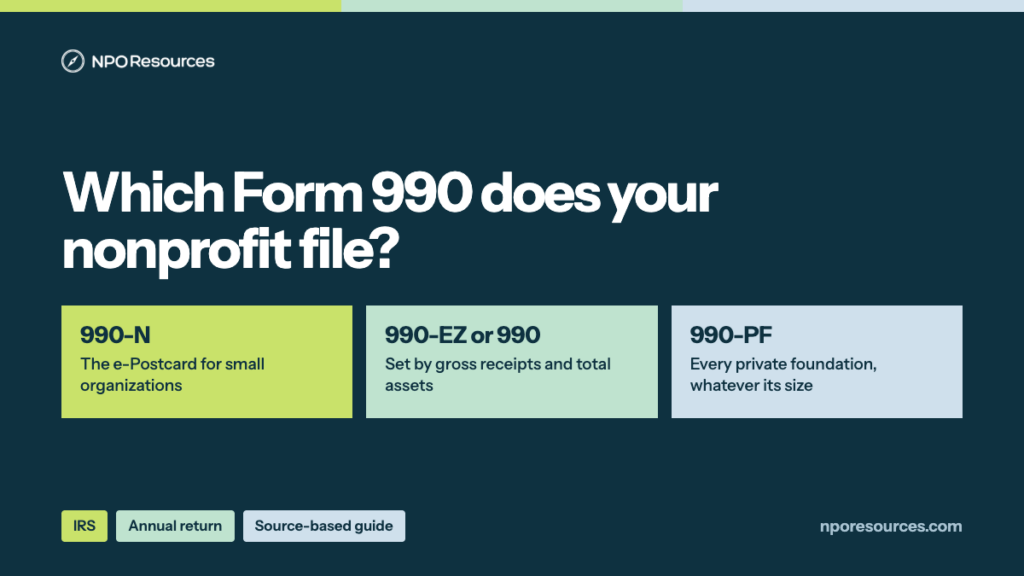
- Form 990 filing requirements come down to one of four filings — 990-N, 990-EZ, 990, and 990-PF — and which one applies is decided by gross receipts, total assets, and whether the organization is a private foundation.
- All four share one deadline: the 15th day of the 5th month after the tax year ends, which is May 15 for calendar-year organizations.
- Form 990-N carries no dollar penalty when it is late, and cannot be extended — the two facts that make it the easiest filing to lose an exemption to.
- Missing any combination of these filings for three consecutive years revokes tax-exempt status automatically, by operation of law, with no appeal.
- Where the second consecutive missed year is one required to be filed after 2019, the IRS is required to notify the organization — so the warning arrives a year before the revocation does.
On this page
- The filing with no penalty is the one that ends exemptions
- Form 990 filing requirements: 990-N, 990-EZ, 990, and 990-PF thresholds
- When Form 990 is due, and the extension that does not cover 990-N
- How to file: e-filing the 990 series and the 990-N e-Postcard
- Form 990 late filing penalties for tax year 2025
- Automatic revocation: the three-year rule and the second-year notice
- How to check your Form 990 filing status with the IRS
- How to get tax-exempt status reinstated after revocation
- Related NPO Resources guides
- Sources reviewed
- Frequently asked questions
The filing with no penalty is the one that ends exemptions
Organizations lose their tax-exempt status over a filing that costs nothing to submit and asks for eight pieces of information.
That sounds like carelessness. It usually is not. It is a predictable result of how the rule is built.
For the smallest annual filing, Form 990-N, the IRS states plainly: “There is no penalty for late submissions.” No daily charge, no cap, no invoice. Nothing arrives to tell a board that a date passed.
And then, three years later, the exemption is gone.
A library card behaves the same way. Keep a book past its date and, at many libraries, nothing happens — no fee, no letter. Nothing happens the second time either.
What eventually happens is not a bill. It is the card being closed. The absence of a small consequence is exactly what allows the large one to arrive unannounced.
This guide covers what the IRS publishes about which filing applies, when it is due, and what a missed one costs. It does not tell you which form your organization should file — that depends on facts only your organization has.
Form 990 filing requirements: 990-N, 990-EZ, 990, and 990-PF thresholds
Form 990 is an annual information return, not an income tax return. It reports finances, governance, and activities rather than computing tax owed, and — with the exception of certain contributor details — it is a public document that anyone can read.
Which version an organization files is set out in an IRS chart. Reduced to its logic:
The connectors carry the weight. Form 990-EZ is available only when both tests are satisfied. The full Form 990 becomes mandatory when either one is tripped. A small organization sitting on a large restricted reserve can be under the receipts line and still owe the full return on assets alone.
Two locks and one lock. The 990-EZ door needs both to be open. The 990 door opens if either one turns.
What “normally $50,000 or less” means
That phrase is not a single-year test. The IRS defines it by how long the organization has existed:
- In existence 1 year or less — received, or was pledged, $75,000 or less in the first tax year
- In existence 1 to 3 years — averaged $60,000 or less across each of the first two tax years
- At least 3 years old — averaged $50,000 or less over the preceding 3 tax years, including the year being calculated
Private foundations and Form 990-PF
Every 501(c)(3) is a private foundation by default. The IRS states that an organization “is a private foundation unless it falls into one of the categories specifically excluded from the definition of that term.”
Private foundations file Form 990-PF whether or not they had income or activity during the year, and they cannot use the e-Postcard at any size.
Churches, conventions or associations of churches, and integrated auxiliaries are excepted from the annual return requirement altogether — they do not file 990-N either.
An organization eligible for the e-Postcard may choose to file the 990-EZ or 990 instead. If it does, the IRS requires a complete return with all applicable schedules; a voluntary filing is not a partial one.
When Form 990 is due, and the extension that does not cover 990-N
All four filings are due by the 15th day of the 5th month after the close of the accounting period. For a calendar-year organization that is May 15. If the date falls on a Saturday, Sunday, or legal holiday, the IRS moves it to the next business day.
Form 8868 requests an automatic 6-month extension, which puts a calendar-year filer at November 15. Two things about it are commonly stated wrong.
It is one extension, not two. The current Form 8868 instructions state that “A single extension of 6 months is allowed for each type of return for a tax year.” Any guidance describing a second request is out of date.
It cannot extend Form 990-N. The IRS says so directly: “Form 8868 cannot be filed to extend the due date of a Form 990-N,” and the Form 8868 instructions repeat it. The smallest filing is the only one with no extension available.
The extension is also conditional. It is granted automatically only if the form is properly completed, filed, and any balance due is paid by the original date.
How to file: e-filing the 990 series and the 990-N e-Postcard
The Taxpayer First Act requires the 990 series to be filed electronically. For the larger filings, the consequence of ignoring that mandate is sharper than it looks:
A paper return mailed against an e-file requirement is not a late filing. It is not a filing. The three-year clock keeps running as though nothing was sent — the way a letter left at a closed office has not been delivered, however carefully it was addressed.
Electronic filing is available only for the current tax year and two prior periods. Older returns must be paper filed.
What the 990-N e-Postcard asks for
Form 990-N (sometimes written 990N) has never had a paper version. The IRS states: “Form 990-N must be completed and filed electronically. There is no paper form.” It is submitted free through the IRS e-Postcard filing system, reached from the IRS Form 990-N page, and the IRS advises against filing from a phone or tablet. Signing in requires an identity-verified account; check the current options on the IRS page before filing, because they have changed.
It cannot be submitted before the tax year has ended.
Form 990 late filing penalties for tax year 2025
For Form 990 and 990-EZ, the penalty under section 6652(c)(1)(A) for tax year 2025 returns is $25 per day, capped at the lesser of $13,000 or 5% of gross receipts for the year, unless reasonable cause is shown. Organizations with gross receipts over $1,309,500 face $130 per day, to a maximum of $65,000 per return. Responsible individuals can be charged $10 per day once an IRS demand period expires, to a maximum of $6,500 across all such persons for any one return. The figures are in the Form 990-EZ instructions.
The same penalty applies to incomplete or incorrect returns, not only late ones. Penalties may be abated for reasonable cause.
These amounts are adjusted annually. The IRS penalties overview page currently carries lower figures than the IRS’s own current instructions, so the instructions are the safer citation.
For Form 990-N, the dollar penalty is zero. That is the whole of the monetary consequence — and the reason this section does not end here.
Watch: the three-year clock
5-minute explainer
Nobody decides to lose exemption. The clock just runs out.
Automatic revocation: the three-year rule and the second-year notice
Failure to file a required annual return or notice for three consecutive years revokes tax-exempt status automatically under Internal Revenue Code section 6033(j). Any mix of the four filings counts. The revocation is effective on the original due date of the third annual return — not the date the IRS notices, and not the date a letter arrives.
It is not a decision that can be argued with. The IRS states that an organization “is automatically revoked by operation of law, and not by a determination made by the IRS,” and that “The law prohibits the IRS from undoing a proper automatic revocation and does not provide for an appeal process.”
A revoked organization is no longer exempt from federal income tax and is not eligible to receive tax-deductible contributions.
The notice most organizations do not know exists
It is often written that the IRS gives no warning. The Form 990-EZ instructions say otherwise:
“After the organization’s second consecutive failure to file their required return or notice, and if the second consecutive year is required to be filed after 2019, the IRS is required to notify the organization with information about how to comply with the filing requirements.”
A notice is required after the second miss. That is a full year before revocation. It is not a grace period and it does not stop the third-year clock, but it means the sequence is not silent.
The IRS also stopped publishing an “at-risk” list after a one-time compliance program that ended in 2010. There is no public roster of organizations approaching revocation.
If a compliance calendar exists, this is the obligation that belongs on it first — the Nonprofit Compliance Calendar Checklist covers how to record an obligation, assign an owner, and verify the date against an official source.
How to check your Form 990 filing status with the IRS
The IRS Tax Exempt Organization Search tool covers Form 990-series returns, e-Postcard submissions, Publication 78 data, determination letters, and the automatic revocation list. Any organization can look itself up.
The revocation list is updated monthly and shows the name, EIN, organization type, last known address, effective date of revocation, the date the organization was added, and, where applicable, the date of reinstatement.
Checking on a schedule rather than after a problem surfaces is the difference between two conversations. A lapse found by a grantmaker during due diligence is not the same as one found by the treasurer in March.
How to get tax-exempt status reinstated after revocation
Reinstatement is governed by Revenue Procedure 2014-11, which the IRS sets out as four routes: streamlined retroactive reinstatement, retroactive reinstatement within 15 months, retroactive reinstatement after 15 months, and post-mark date reinstatement.
Three points that are frequently misstated:
- Reinstatement requires filing an application for exemption and paying the user fee even if the organization was never required to apply originally.
- A private foundation cannot use the streamlined route. It is limited to organizations that were eligible to file Form 990-EZ or 990-N for the three years that caused the revocation. A foundation seeking retroactive reinstatement must use a route requiring a reasonable-cause statement; post-mark date reinstatement remains open to it without one.
- Applying more than 15 months after revocation requires establishing reasonable cause for all three years, not one. The streamlined route can also be used only once.
Related NPO Resources guides
- Nonprofit Compliance Calendar Checklist — how to build the obligation inventory this filing belongs to, assign an owner, and verify each date against an official source.
- Charitable Solicitation Registration: What Triggers It — the separate state duty that runs alongside this federal return, and why some states accept the Form 990 as their own report.
- Nonprofit Data Backup and Account Recovery Checklist — account access and record continuity, which is what makes a filing possible when the person who used to do it has left.
- TechSoup QuickBooks for Nonprofits — bookkeeping and discount access, upstream of the figures a 990 reports.
- Form 1023 vs 1023-EZ — which 501(c)(3) application applies, and why the annual filing obligation starts before the IRS letter arrives.
- Compliance Resource Finder — state and federal compliance references collected in one place.
- Nonprofit Conflict of Interest Policy: What Form 990 Asks — what Part VI of this return asks about governance policies, and why Section B says the Code does not require them.
- Private Foundation Rules: Five Restrictions and Form 990-PF — what Form 990-PF asks once you know a private foundation files it, including the five Chapter 42 restrictions and the 5% distribution figure.
Need help with Form 990 preparation?
GivingArc | Nonprofit accounting
Bookkeeping, monthly close, Form 990 preparation, grant tracking, and reporting support built for nonprofits.
Sources reviewed
Information reviewed on 2026-08-31 against the IRS pages linked above and below. Every figure in this guide was confirmed on the IRS page it links to. IRS thresholds, penalty amounts, and procedures change; verify current requirements before filing.
- Annual electronic filing requirement for small exempt organizations — Form 990-N (e-Postcard)
- Form 990-N FAQs: how to file
- Form 990-N: organizations not permitted to file
- Form 990 series: which forms do exempt organizations file
- Instructions for Form 990 (2025) and Instructions for Form 990-EZ (2025)
- Annual exempt organization return: who must file
- Annual exempt organization return: due date and the return due dates table
- Extension of time to file exempt organization returns, About Form 8868, and Instructions for Form 8868 (Rev. January 2026)
- Private foundations and the private foundation annual return
- Automatic revocation of exemption, IRS cannot restore status, and the automatic revocation FAQs (PDF, undated)
- Automatic revocation: how to have your tax-exempt status reinstated
- Tax Exempt Organization Search and its search guidance
- E-file for charities and nonprofits
- Annual exempt organization return: penalties for failure to file
Frequently asked questions
An organization whose gross receipts are normally $50,000 or less may satisfy the annual requirement with Form 990-N. Above that, Form 990-EZ is available only when gross receipts are under $200,000 and total assets are under $500,000. If either figure reaches its threshold, the full Form 990 is required. Private foundations file Form 990-PF at any size.
No. Form 990 is an annual information return. It reports an organization’s finances, governance, and activities rather than computing income tax owed, and apart from certain contributor details it is a public document.
The 15th day of the 5th month after the end of the organization’s accounting period, which is May 15 for a calendar-year organization. If the date falls on a weekend or legal holiday, it moves to the next business day.
Form 8868 provides an automatic 6-month extension for Form 990, 990-EZ, and 990-PF, moving a calendar-year deadline to November 15. Only one 6-month extension is allowed per return per tax year, and Form 8868 cannot be used to extend Form 990-N.
For tax year 2025 returns, Form 990 and 990-EZ carry a penalty of $25 per day up to the lesser of $13,000 or 5% of gross receipts. Form 990-N has no dollar penalty. In all cases, three consecutive years without a required filing revokes tax-exempt status automatically under section 6033(j).
Yes — at minimum once. Where the second consecutive missed year is one required to be filed after 2019, the IRS is required to notify the organization. That notice does not pause the three-year clock, and the IRS no longer publishes an “at-risk” list of organizations approaching revocation.